YouTube does not pay a fixed amount per view. For a US audience, a long video usually earns somewhere between $0.0007 and $0.022 per view, which is about $0.66 to $22 for every 1,000 views. A Short earns far less: roughly $0.00003 to $0.00015 per view. Where you land in that range depends on your topic, your video length, where your viewers live, and the month.
Those numbers are estimates, not promises. The rest of this page shows where they come from, with the maths, so you can work out your own number.
Why your views and your earnings don’t seem to match
You open YouTube Studio. A video has 50,000 views. Your earnings say $61. You do the division and get about a tenth of a cent per view. Then you read online that YouTube pays “3 to 5 cents a view” and wonder what went wrong.
Nothing went wrong. This is one of the most common worries in creator communities, and the cause is nearly always the same. The “cents per view” numbers people pass around are not what creators receive. They are usually what advertisers pay, before YouTube takes its cut and before you count all the views that never showed an ad.
Most articles on this topic stop at one average number. An average doesn’t help you, because a finance channel and a gaming channel can earn very different amounts from the same views. So this guide walks through the steps the money takes instead.
YouTube doesn’t pay per view. Here’s what it pays for
YouTube pays you a share of what advertisers spend on ads shown on your videos. No ad, no ad money. Four things happen between a view and your payout.
- Someone watches your video. That is one view.
- Maybe an ad plays. Not every view gets one. YouTube’s own help page says a view may have no ad when the video isn’t advertiser-friendly, ads are off, no ad matches the viewer, or the viewer has YouTube Premium. See YouTube’s page on ad revenue analytics. Our calculator assumes 40% to 60% of views show an ad. That’s our planning assumption, not an official YouTube figure.
- The advertiser pays for that ad. This price is called CPM, which means the cost for 1,000 ad showings. CPM depends on your topic and on where the viewer lives.
- YouTube splits the money. For ads on regular videos, creators in the YouTube Partner Program get 55% and YouTube keeps 45%. This is stated on the YouTube partner earnings overview.
What’s left, measured across all your views, is called RPM: the money you earn for every 1,000 views. Divide RPM by 1,000 and you have your pay per view.
Here’s the same thing as a formula:
RPM = CPM × share of views with an ad × 55% × mid-roll boost
Pay per view = RPM ÷ 1,000
The mid-roll boost is 1.0 for videos under 8 minutes and 1.5 for videos of 8 minutes or more. We explain why further down.
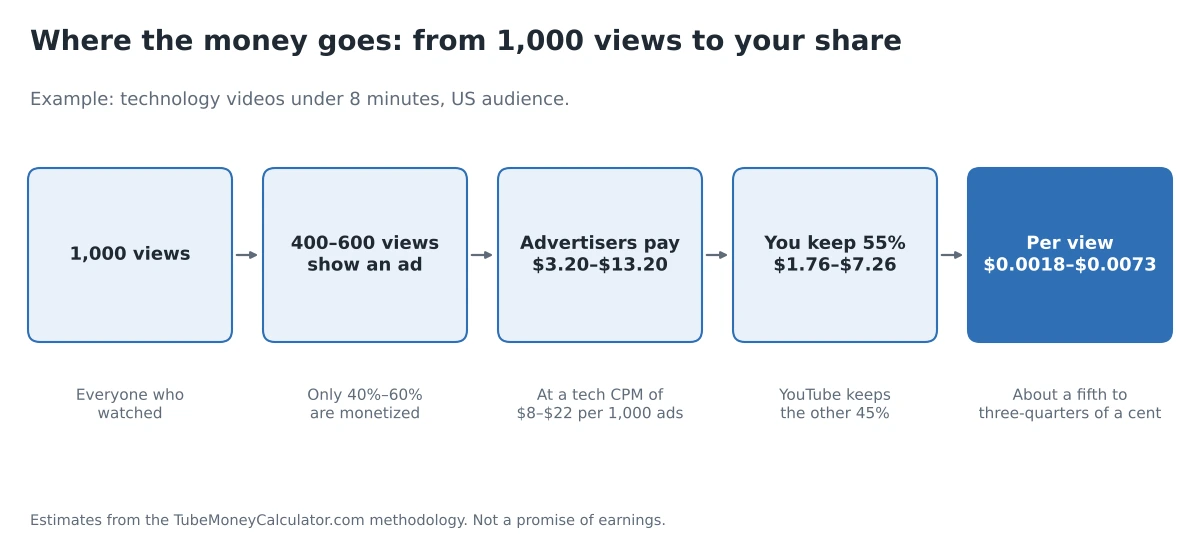
Let’s run it once with real numbers. Take technology videos under 8 minutes with a US audience. Our methodology page uses a CPM of $8 to $22 for technology.
- Low end: $8 × 40% × 55% = $1.76 per 1,000 views. That’s $0.0018 per view.
- High end: $22 × 60% × 55% = $7.26 per 1,000 views. That’s $0.0073 per view.
So an advertiser might pay close to a cent or two per ad, and you still end up with a fraction of a cent per view. Both numbers are true. They just measure different things.
How much YouTube pays per view, by niche
Your topic is the biggest lever after your audience’s country. Advertisers pay more to reach someone watching a video about investing than someone watching a funny clip, because the first viewer is closer to buying something expensive.
The table below uses a US audience and videos of 8 minutes or more. The numbers come straight from the formula above and the CPM ranges on our methodology page.
| Niche | Per 1,000 views | Per single view |
|---|---|---|
| Finance & investing | $4.95 to $22.28 | $0.0050 to $0.0223 |
| Technology | $2.64 to $10.89 | $0.0026 to $0.0109 |
| Education | $2.64 to $9.90 | $0.0026 to $0.0099 |
| Health & fitness | $2.31 to $8.91 | $0.0023 to $0.0089 |
| Food & cooking | $1.32 to $5.94 | $0.0013 to $0.0059 |
| Entertainment | $0.99 to $4.46 | $0.0010 to $0.0045 |
| Vlogs & lifestyle | $0.99 to $3.96 | $0.0010 to $0.0040 |
| Gaming | $0.66 to $3.96 | $0.0007 to $0.0040 |
| Shorts (any niche) | $0.03 to $0.15 | $0.00003 to $0.00015 |
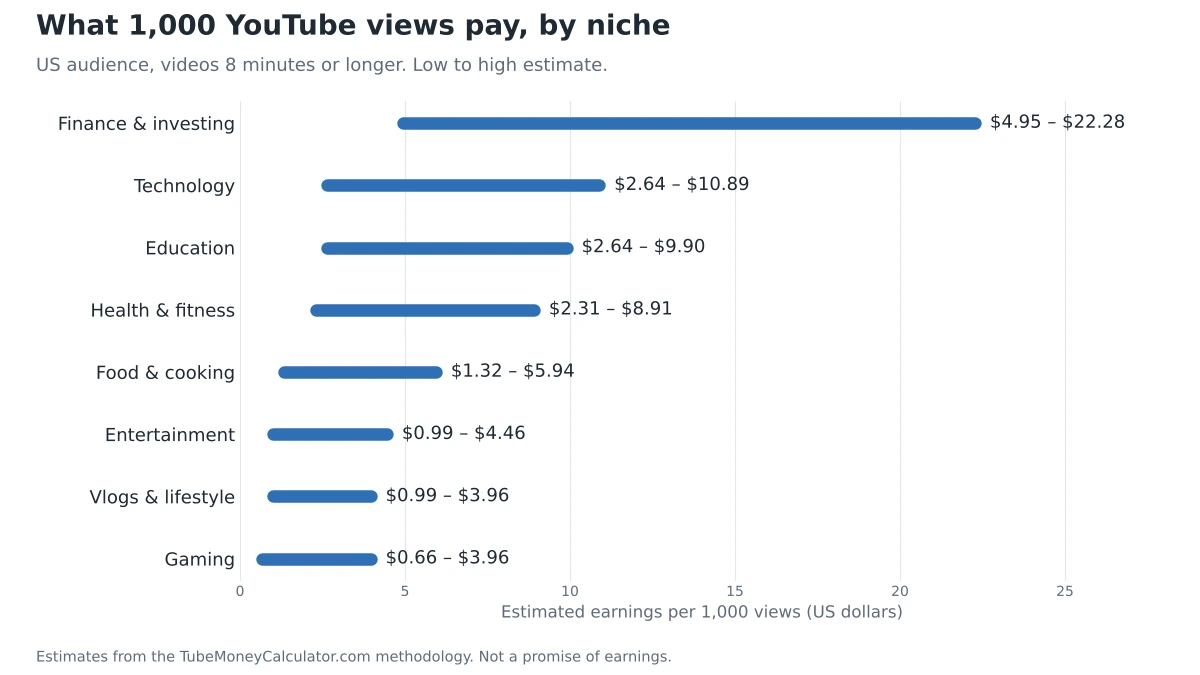
Three notes on reading this table.
- Shorter videos earn less. For videos under 8 minutes, divide each long-video number by 1.5. Gaming becomes $0.44 to $2.64 per 1,000 views.
- Canada is a little lower. Our calculator applies 0.85 for a Canadian audience, so multiply by 0.85. Technology becomes $2.24 to $9.26 per 1,000 views.
- The ranges are wide on purpose. A narrow number would look more confident, but it would be less honest. Two channels in the same niche can sit at opposite ends.
How to work out your own pay per view
If your channel already earns money, you don’t need an estimate. You have the real number.
- Open YouTube Studio and click Analytics.
- Click the Revenue tab.
- Set the date range to the last 28 days.
- Find RPM. Divide it by 1,000. That’s your real pay per view.
An RPM of $3.40 means $0.0034 per view. One thing to know: YouTube’s RPM also counts memberships, Super Chat and YouTube Premium money, not only ads. So your Studio number can be a little higher than an ads-only estimate.
If your channel isn’t monetised yet, estimate it instead.
- Open the YouTube money calculator.
- Enter the views you expect in a month.
- Pick the country where most of your viewers live, not where you live.
- Pick your niche and your usual video length.
- Read the low and high result, then divide each by your views.
If you want help with any of those inputs, our earlier post on how to use a YouTube money calculator covers each one.
Worked example 1: a US cooking channel with 50,000 views
Picture a home cooking channel. Most viewers are in the United States. The videos run about 6 minutes, and the channel gets 50,000 views in a month.
Food & cooking has a CPM of $4 to $12 in our methodology. Videos under 8 minutes get no mid-roll boost.
| Step | Low | High |
|---|---|---|
| CPM for food & cooking | $4.00 | $12.00 |
| × share of views with an ad (40% to 60%) | $1.60 | $7.20 |
| × 55% creator share = RPM | $0.88 | $3.96 |
| × 50 (50,000 views is 50 thousands) | $44.00 | $198.00 |
| Pay per view | $0.00088 | $0.00396 |
So 50,000 views is worth about $44 to $198 for this channel. If the creator saw $61 in Studio, that’s not a mistake. It sits inside the normal range, toward the lower end.
Now change one thing. If the same videos ran 8 minutes or more, the estimate becomes $66 to $297. Same views, same audience, about 50% more money.
Worked example 2: a Canadian personal finance channel with 20,000 views
Now a much smaller channel. It covers personal finance, most viewers are in Canada, and the videos run 10 minutes. It gets 20,000 views in a month.
Finance has a CPM of $15 to $45. Canada gets a 0.85 multiplier. Videos of 8 minutes or more get the 1.5 mid-roll boost.
| Step | Low | High |
|---|---|---|
| CPM for finance | $15.00 | $45.00 |
| × 0.85 for a Canadian audience | $12.75 | $38.25 |
| × share of views with an ad (40% to 60%) | $5.10 | $22.95 |
| × 55% creator share | $2.81 | $12.62 |
| × 1.5 mid-roll boost = RPM | $4.21 | $18.93 |
| × 20 (20,000 views is 20 thousands) | $84.15 | $378.68 |
| Pay per view | $0.0042 | $0.0189 |
All amounts are in US dollars. This channel has less than half the views of the cooking channel, yet its estimate is higher: about $84 to $379. That’s the whole lesson of this article in one comparison. Views alone tell you very little.
Why 8 minutes matters
YouTube lets you place ads in the middle of a video only when it’s 8 minutes or longer. YouTube’s help page on mid-roll ad breaks confirms the 8-minute rule. More ad slots usually means more money per view, which is why our calculator applies a 1.5 boost at 8 minutes.
This isn’t a reason to stretch a 5-minute idea into 8 minutes. If viewers leave early, they never reach the mid-roll, and the video may get fewer views overall.
What about Shorts?
Shorts work differently, and this is where a lot of frustration comes from.
Ads don’t play on your Short. They play between Shorts in the feed. YouTube adds that ad money together each month into a pool. Part of it covers music licensing. The rest is shared among creators based on their share of Shorts views, and creators keep 45% of their part. YouTube explains this on its Shorts monetization policies page.
The result is a very small amount per view. Our calculator uses $0.03 to $0.15 per 1,000 Shorts views for a US audience. So 1 million Shorts views comes to about $30 to $150. One million long gaming views with the same audience comes to about $660 to $3,960.
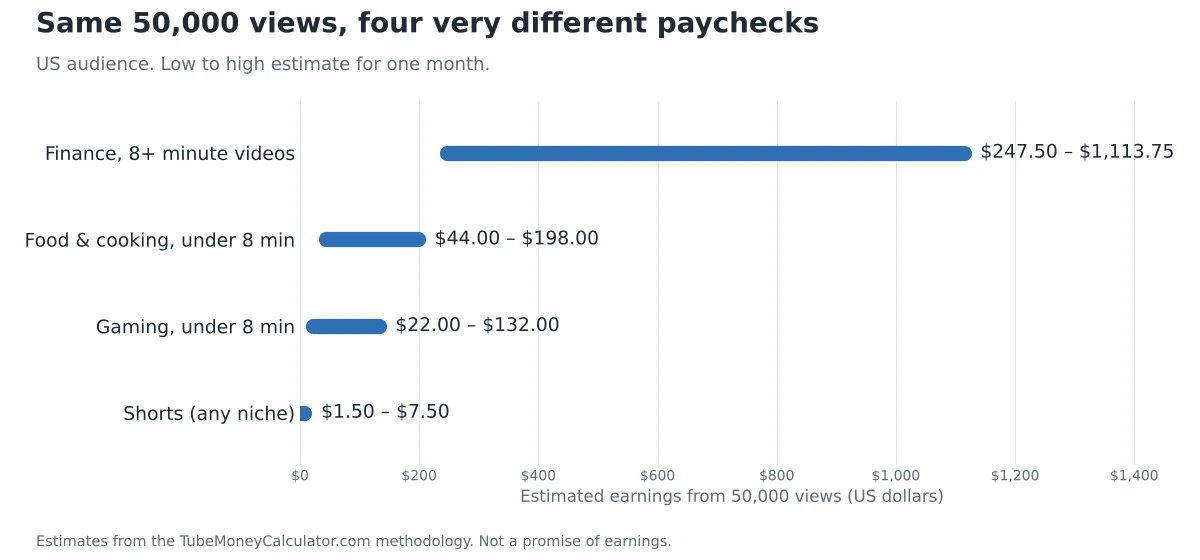
Shorts can still be worth making. They’re good at bringing new people to your channel. Just don’t plan your income around Shorts views.
Why the same views pay less in January
Advertisers spend the most before the holidays and pull back right after. So your pay per view moves through the year even if nothing about your channel changes.
Our calculator has an optional month setting for this. It uses 0.75 for January and 1.35 for December. Apply that to the cooking channel from example 1:
- January: $44 to $198 becomes $33.00 to $148.50.
- December: $44 to $198 becomes $59.40 to $267.30.
If your earnings drop in January while your views hold steady, this is the most likely reason. It usually recovers through the spring.
Frequently asked questions
How many views do you need to make $100 on YouTube?
It depends on your RPM. Divide $100 by your RPM, then multiply by 1,000. For US technology videos of 8 minutes or more, our estimate is roughly 9,200 to 37,900 views. For gaming it’s more, and for finance it’s fewer. The Goal Calculator on our home page does this maths for you.
Does YouTube pay you for views before you’re monetised?
No. You earn ad money only after you join the YouTube Partner Program. For ad revenue you need 1,000 subscribers, plus either 4,000 valid public watch hours in the last 12 months or 10 million valid public Shorts views in the last 90 days. YouTube also reviews your channel before accepting it. The current rules are on YouTube’s Partner Program page.
Is CPM the same as what I get paid?
No. CPM is what advertisers pay for 1,000 ad showings, before YouTube’s share. RPM is what you earn for 1,000 views, after YouTube’s share and counting views with no ad. RPM is always the lower number, and it’s the one that matters for your bank account. Our post on YouTube RPM goes through the difference in detail.
Do subscribers change how much I earn per view?
Not directly. YouTube doesn’t pay for subscribers. They help because they tend to watch more of your videos, which means more views.
Why is my real number different from the estimate?
An estimate uses typical ranges. Your channel has its own mix of viewers, ad settings and watch time. YouTube itself says there are no guarantees about how much you’ll be paid. Treat any calculator, including ours, as a planning tool. Our guide and how it works pages explain the limits in more detail.
Your next step
Stop asking what YouTube pays per view in general, and find out what it pays per view for a channel like yours.
If you’re monetised, open YouTube Studio, find your RPM for the last 28 days, and divide by 1,000. If you’re not, put your niche, country and video length into the YouTube money calculator and look at the low and high result. Then plan around the low end. If the high end shows up, it’s a nice surprise instead of a missed target.