You finally got close. Maybe you’re sitting at 2,900 watch hours and 800 subscribers, and you had a date in your head for when you’d hit 4,000. Then you see a headline: “YouTube doubles the watch hours you need.” Or you run a Shorts channel that already earns a little, and someone in a comment section says your Shorts money is about to disappear.
It’s a lot to take in, and many of the posts about it mix up who the new rules apply to. So let’s slow down and go through it in plain English, using only what YouTube itself has published.
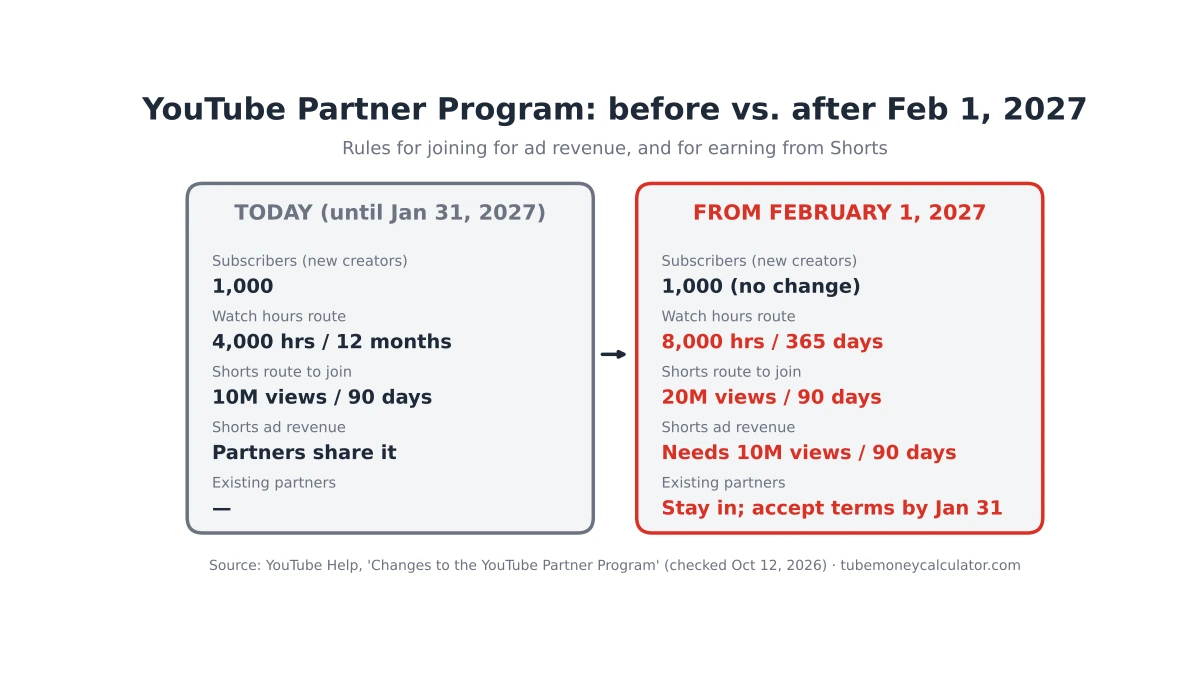
The short answer: Starting February 1, 2027, new creators who want ad revenue need 1,000 subscribers plus 8,000 qualified watch hours in the last 365 days (or 20 million qualified Shorts views in 90 days). Creators already in the Partner Program keep their place. But every channel will need 10 million qualified Shorts views in 90 days to keep earning from Shorts ads, and every partner must accept new terms in YouTube Studio by January 31, 2027.
Where these facts come from
YouTube announced the changes on its official blog on August 10, 2026. The details, including the subscriber rule and the deadline for accepting terms, are on the Help Center page Changes to the YouTube Partner Program.
I checked both pages on October 12, 2026. YouTube may still adjust details before February, so if you’re reading this later, check those two pages too. Where YouTube hasn’t shared details yet, I say “not announced yet” instead of guessing.
The 5 changes, one by one
1. New creators need 8,000 watch hours instead of 4,000
Today, you can join the Partner Program for ad revenue with 1,000 subscribers and 4,000 qualified watch hours in the last 12 months, or 1,000 subscribers and 10 million qualified Shorts views in the last 90 days.
From February 1, 2027, new applicants need:
- 1,000 subscribers, plus
- 8,000 qualified watch hours in the last 365 days, or
- 20 million qualified Shorts views in the last 90 days.
One common mix-up: the blog announcement doesn’t mention subscribers, so some articles claimed the subscriber rule was gone. The Help Center page clearly says you still need 1,000 subscribers.
2. Shorts revenue now needs 10 million views every 90 days
Starting February 1, 2027, only channels with 10 million qualified Shorts views in the last 90 days share in Shorts ad and subscription revenue.
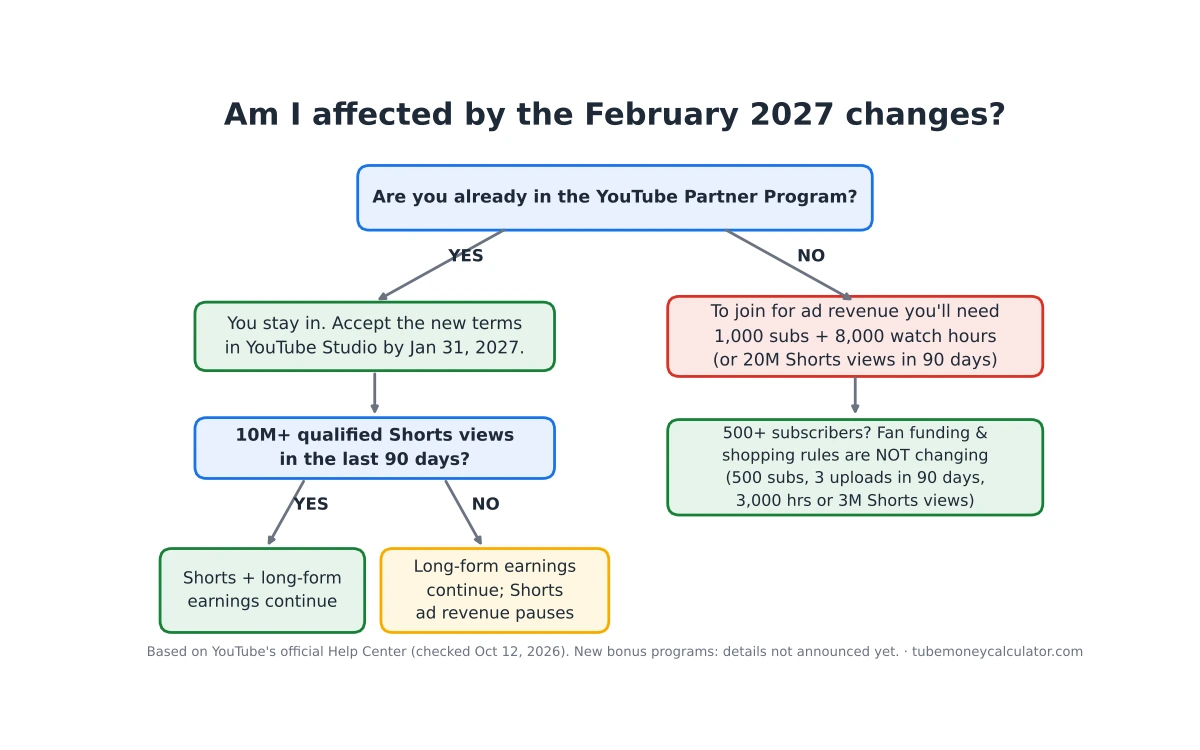
This is the part that scares people the most, so here’s the key detail. If your channel drops below 10 million, you’re not removed from the Partner Program. You keep earning from long-form videos, and Shorts revenue sharing starts again on its own once you’re back above 10 million.
3. Existing partners keep their place
The Help Center says that if you’re already in the Partner Program, your status isn’t impacted by this update. So if you’re already a partner, you don’t have to re-qualify with 8,000 hours.
But “not impacted” applies to your membership. The 10 million Shorts rule and the new activity rule (below) still apply to everyone.
4. You must accept new terms by January 31, 2027
Every partner needs to review and accept the updated terms in YouTube Studio by January 31, 2027. This covers the Watch Page Monetization Module, the Shorts Monetization Module and, where it applies, the Commerce Product Module.
If you don’t accept, you stop earning from those features starting February 1. You won’t be kicked out, and you can accept later to switch earnings back on. But there’s no reason to lose days of income, so do it early.
5. A clearer “active channel” rule
From February 1, your channel counts as active if it meets any one of these:
- 1,000 qualified watch hours in the past 365 days, or
- 1 million qualified Shorts views in the last 90 days, or
- 2 long-form videos or 5 Shorts uploaded every 90 days.
Channels that drop below get a 90-day window to get back on track. For a solo creator, the upload option is the easiest to control: two long videos every three months.
What stays the same
- Fan funding and shopping: YouTube says these entry thresholds aren’t changing. Today that means 500 subscribers, 3 public uploads in the last 90 days, and either 3,000 qualified watch hours in 12 months or 3 million qualified Shorts views in 90 days. The United States is on the eligible country list.
- The revenue split: creators still get 55% of the revenue for long-form videos and 45% for Shorts, according to the official announcement.
Two other changes that affect your earnings
Premium Lite is expanding. Premium Lite, the cheaper YouTube Premium plan, is coming to every country where Premium is offered. Each plan gets its own money pool: 30% of net Premium revenue and 60% of net Premium Lite revenue. That pool is split by how much members watch, and creators get 55% for long-form and 45% for Shorts.
New incentives for smaller Shorts channels. YouTube says channels under the Shorts threshold will get new incentives: Shopping bonuses, brand-deal incentives, and earnings boosts for starting or growing trends. Amounts, rules and launch dates are not announced yet. Anyone quoting numbers for these today is guessing.
What “qualified” means (this decides what counts)
YouTube explained this in a separate post on August 12, 2026:
- Qualified watch hours come from public long-form videos (podcasts included) or archived livestreams. Watch time from private, unlisted or deleted videos, from Shorts, or from videos shown as ads doesn’t count.
- Qualified Shorts views are “engaged views” on public Shorts, meaning the viewer watched past the first few seconds. Loops don’t count.
So Shorts can bring you subscribers, but their watch time does nothing for your 8,000 hours.
Who is affected? A quick check
| Your situation on February 1, 2027 | What changes for you |
|---|---|
| Already in the Partner Program, mostly long-form | Accept the new terms by Jan 31. Your ad earnings carry on as normal. |
| Already a partner, Shorts views above 10M per 90 days | Accept the terms. Shorts earnings continue. |
| Already a partner, Shorts views below 10M per 90 days | You stay a partner. Shorts ad revenue pauses; long-form earnings continue. |
| Not yet a partner, aiming for ad revenue | You need 1,000 subscribers + 8,000 watch hours, or 20M Shorts views in 90 days. |
| Not yet a partner, 500+ subscribers | Fan funding and shopping rules are unchanged, so these may be open to you now. |
Worked example 1: How many views is 8,000 watch hours?
Watch hours depend on two things: how many views you get and how long people watch each time (your average view duration, shown in YouTube Studio under Analytics).
The maths:
- 8,000 hours × 60 = 480,000 minutes of watching.
- If people watch 4 minutes on average: 480,000 ÷ 4 = 120,000 views in 365 days.
- Under the old 4,000-hour rule, the same channel needed 60,000 views.
Now spread that over a year of uploads:
- 2 videos a week = 104 videos. 120,000 ÷ 104 = about 1,154 views per video.
- 1 video a week = 52 videos. 120,000 ÷ 52 = about 2,308 views per video.
And see how much watch time matters:
| Average view duration | Views needed for 8,000 hours |
|---|---|
| 2 minutes | 240,000 |
| 3 minutes | 160,000 |
| 4 minutes | 120,000 |
| 6 minutes | 80,000 |
| 8 minutes | 60,000 |
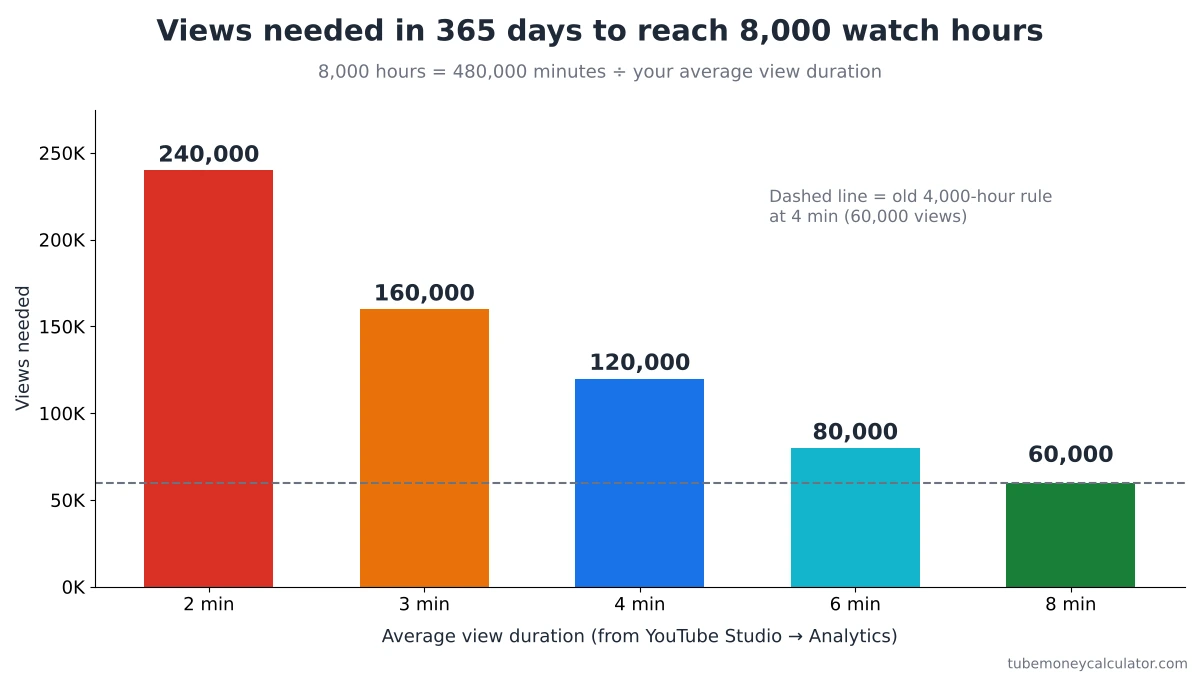
Going from 2 minutes to 4 minutes of average watch time cuts the views you need in half. For a solo creator, that’s usually easier than doubling your audience. Tighter intros, clear chapters and videos that deliver what the title promises all help.
One warning: the window is a rolling 365 days. Watch hours older than a year drop off, so a video that got views 13 months ago no longer counts.
Worked example 2: A Shorts channel below 10 million
Say a US creator is already a partner and gets 6 million qualified Shorts views every 90 days, plus 30,000 long-form views a month on 10-minute gaming videos.
Using the numbers from the TubeMoneyCalculator methodology, US Shorts earn about $0.03 to $0.15 per 1,000 views:
- 6,000,000 ÷ 1,000 = 6,000
- 6,000 × $0.03 = $180, and 6,000 × $0.15 = $900 per 90 days
From February 1, that Shorts share pauses, because 6 million is under 10 million.
The long-form income keeps going. For gaming videos of 8+ minutes with a US audience, the calculator’s RPM (what you earn per 1,000 views) is:
- Low: $2 CPM × 40% of views monetised × 55% creator share × 1.5 (mid-roll boost) = $0.66
- High: $8 × 60% × 55% × 1.5 = $3.96
- 30,000 views ÷ 1,000 = 30, so 30 × $0.66 = $19.80 to 30 × $3.96 = $118.80 a month
These are estimates, not promises. But they show why long-form videos are now the steadier income for small channels.
Worked example 3: A Canadian creator caught in the middle
A creator in Toronto makes education videos. On February 1, 2027, they have 1,000 subscribers and 5,000 qualified watch hours, but they haven’t been accepted into the program yet.
- Under today’s rules, 5,000 hours is more than 4,000, so they qualify.
- Under the new rules, they need 3,000 more hours. At a 4-minute average view duration: 3,000 × 60 ÷ 4 = 45,000 more views.
What could they earn once accepted? With a Canadian audience (the calculator uses 0.85 of US ad rates) and videos over 8 minutes, education works out to about $2.24 to $8.42 RPM. At 10,000 views a month, that’s roughly $22 to $84 a month. You can test your own numbers in the Earnings Estimator.
Should you apply before February 1?
If you already meet today’s rules (1,000 subscribers plus 4,000 watch hours or 10 million Shorts views), applying now makes sense. Once you’re in, the Help Center says your status isn’t affected.
What YouTube hasn’t announced yet is how it will handle an application sent in January but reviewed after February 1. So apply as early as you can, and don’t wait until the last week. This series will cover the question in detail in a later article.
What to do this week: a simple checklist
- Open YouTube Studio → Earn. See whether you’re a partner and how close you are to each threshold.
- If you’re a partner: look for the updated terms and accept all modules well before January 31, 2027.
- Check your Shorts views for the last 90 days in Analytics. If you’re well under 10 million, plan more long-form videos instead of counting on Shorts income.
- Write down your average view duration. Use the table above to see how many views you need for 8,000 hours.
- If you have 500+ subscribers, check whether fan funding or shopping is open to you. Those rules aren’t changing.
- Estimate your future income with the calculator so your goals are realistic. If RPM is new to you, read YouTube RPM explained.
FAQ
Do I still need 1,000 subscribers after February 2027?
Yes. YouTube’s Help Center lists 1,000 subscribers together with 8,000 qualified watch hours or 20 million qualified Shorts views for new creators.
I’m already monetised. Will I lose monetisation?
No. The Help Center says partners’ status isn’t affected. You do need to accept the new terms by January 31, 2027 to keep earning from every feature, and Shorts ad revenue needs 10 million qualified Shorts views in 90 days.
Do Shorts views count toward 8,000 watch hours?
No. Only watch time from public long-form videos and archived livestreams counts. Shorts have their own route (20 million qualified views in 90 days).
When will YouTube share details of the new bonuses?
Not announced yet. YouTube has only said it will “share more details soon.”
Does this change the 55/45 revenue split?
No. YouTube’s announcement still lists 55% for long-form and 45% for Shorts.
The bottom line
The bar for new creators is higher, and Shorts alone will pay fewer small channels. But nobody already in the program is pushed out, fan funding stays within reach at 500 subscribers, and long-form videos that hold attention are now worth even more.
If you’ve seen claims that contradict any of this, we check the ten most common ones against YouTube’s own pages in 10 myths about YouTube’s 2027 monetization changes.
Your next step: open YouTube Studio, write down your watch hours and average view duration, and use the table above to set a realistic monthly views target. Then put those views into the Views to Money calculator to see what the goal could be worth. If you’re still unsure how the money side works, our guide on how many views you need to make money on YouTube walks through it step by step. (Note: it uses today’s 4,000-hour rule, which applies until 31 January 2027.)