You finally made peace with the 4,000-hour goal. You check YouTube Studio every morning, and the bar creeps forward a few hours at a time. Then you read that new applicants will need 8,000 hours starting February 1, 2027, and the finish line suddenly moves twice as far away.
Short answer: 8,000 watch hours in 365 days works out to about 667 hours a month, or roughly 22 hours of viewing every single day. For a channel posting two videos a week with a 5-minute average view duration, that means about 924 views per video. Most small channels need somewhere between one and three years to get there. The exact time depends on three numbers you control, and this article shows you how to find yours.
Everything below is math you can check yourself. Nothing here is a promise. YouTube decides what counts, and your channel’s numbers will be different from my examples.
What exactly is changing (and what isn’t)
Here is what YouTube has confirmed on its official pages, as of October 15, 2026:
| Rule | Today | From February 1, 2027 (new applicants) |
|---|---|---|
| Watch hours path | 4,000 qualified watch hours in the last 12 months | 8,000 qualified watch hours in the last 365 days |
| Shorts path | 10 million qualified Shorts views in the last 90 days | 20 million qualified Shorts views in the last 90 days |
| Subscribers | 1,000 | YouTube’s announcement does not mention a change |
| Already in the Partner Program? | — | Not affected by the new entry bar |
The current rules come from YouTube’s Partner Program eligibility page. The 2027 numbers come from YouTube’s official announcement. One detail is worth knowing: as of today, the Help page still lists the 4,000-hour rule and has not yet been updated with the 8,000-hour number. It does say that current partners must accept the updated terms in YouTube Studio by January 31, 2027. Check both pages again before you plan around them, because YouTube can update them before February.
If you’re already a partner, this article isn’t about you. You may want our guide on the 10 million Shorts views rule instead.
What counts as a “qualified” watch hour
Before doing any math, it helps to know which hours count. According to YouTube’s eligibility page:
Counts:
- Watch time on public long-form videos
- Public livestreams that stay on your channel as a video afterward
Does not count:
- Shorts (even watch time from Shorts in the Shorts feed)
- Private, unlisted or deleted videos
- Views from ad campaigns (paying to promote a video does not buy you qualified hours)
- Livestreams that are unlisted, deleted, or not saved as a video
This matters a lot. If you post mostly Shorts, your watch-hour bar may barely move, however many Shorts views you get.
The formula: three numbers decide everything
Watch hours are simple multiplication:
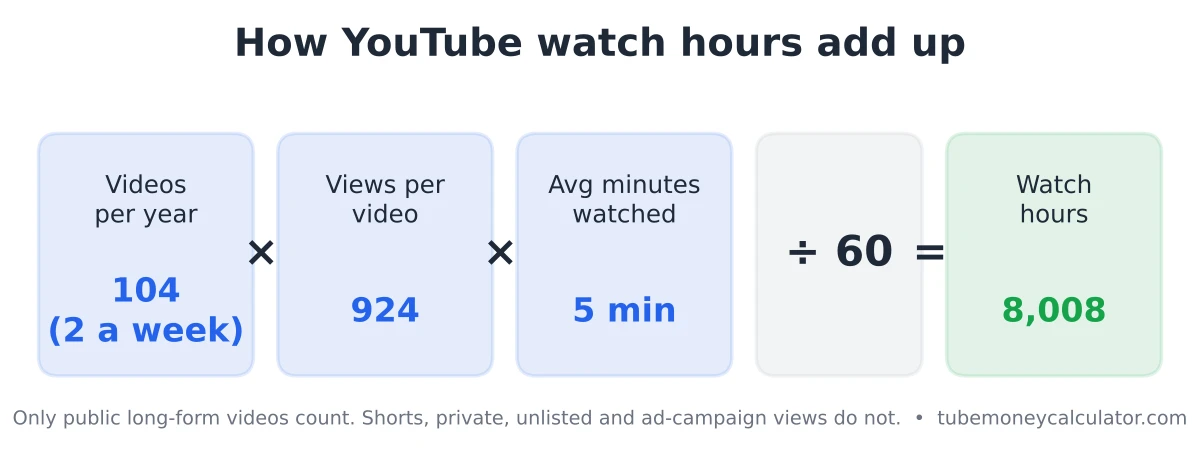
Videos × Views per video × Average minutes watched ÷ 60 = Watch hours
“Average minutes watched” is YouTube’s average view duration: the average number of minutes people watched each view (YouTube Help). You can find it in YouTube Studio under Analytics → Engagement.
8,000 hours is 480,000 minutes. So to work out the views you need, flip the formula:
Views needed per video = 480,000 ÷ average minutes watched ÷ number of videos
Worked example 1: The weekly uploader
Jake runs a woodworking channel in Ohio. He posts one 10-minute video a week, and viewers watch about 4 minutes on average.
- Videos in a year: 1 × 52 = 52 videos
- Minutes needed per video: 480,000 ÷ 52 = about 9,231 minutes
- Views needed per video: 9,231 ÷ 4 = about 2,308 views
- Total views in the year: 2,308 × 52 = about 120,000 views
If Jake’s videos average 600 views today, he’s at roughly a quarter of what he needs, or about 2,080 hours a year. That’s a long road, and it’s better to know that now than in month eleven.
Worked example 2: The twice-a-week uploader
Maria makes cooking videos from Toronto. She posts two 12-minute videos a week, and viewers watch about 5 minutes.
- Videos in a year: 2 × 52 = 104 videos
- Minutes needed per video: 480,000 ÷ 104 = about 4,615 minutes
- Views needed per video: 4,615 ÷ 5 = about 924 views
- Check: 104 × 924 × 5 ÷ 60 = 8,008 hours ✅
Twice the videos and one extra minute of watch time cut her views-per-video target by more than half compared with Jake.
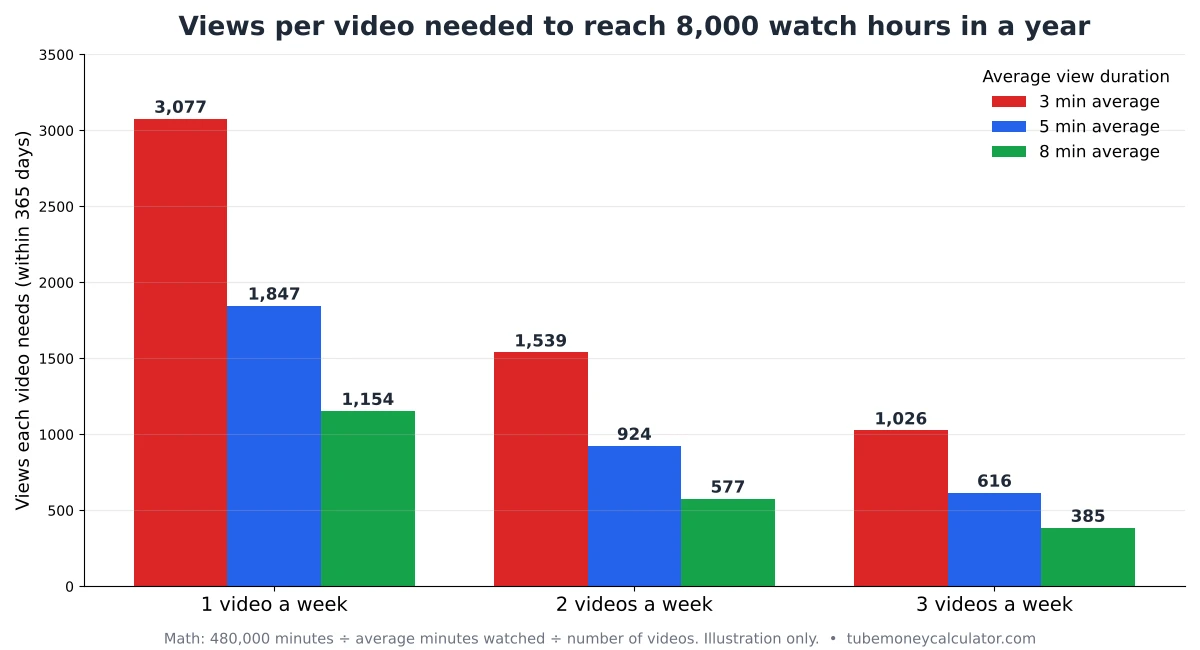
Here’s the full picture for common posting paces:
| Upload pace | 3-min average view | 5-min average view | 8-min average view |
|---|---|---|---|
| 1 video a week | 3,077 views per video | 1,847 | 1,154 |
| 2 videos a week | 1,539 | 924 | 577 |
| 3 videos a week | 1,026 | 616 | 385 |
These numbers assume each video collects its views inside the same 365-day window. In real life, older videos keep adding hours too, which helps (more on that below).
The trap most people miss: the 365-day window
This is the part almost nobody explains, and it’s why so many channels feel “stuck.”
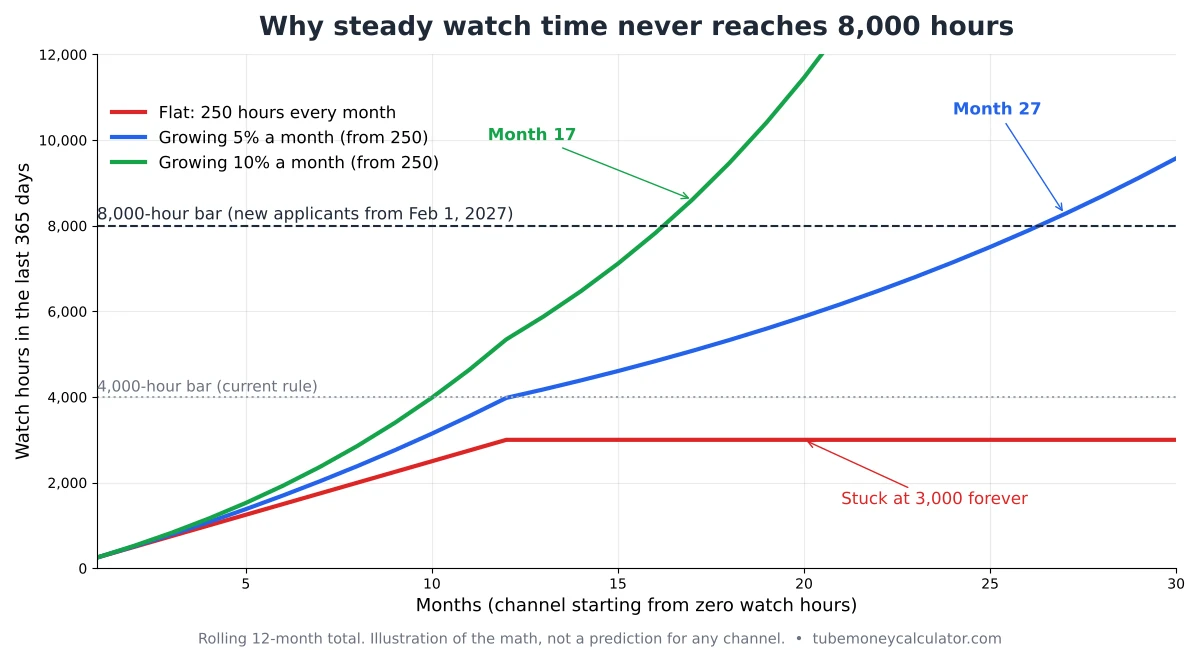
The requirement is 8,000 hours in the last 365 days. It’s a rolling window. Every day, the watch time from exactly one year ago drops off your total.
That creates a hard ceiling:
Your maximum possible total = your monthly watch hours × 12
So if your channel steadily earns 250 watch hours a month, your 365-day total will level off at 3,000 hours, no matter how long you wait. It will never reach 4,000, let alone 8,000. To reach 8,000, your channel has to grow until it earns about 667 hours every month.
Worked example 3: How long growth actually takes
Let’s say a channel starts from zero today and earns 250 watch hours in its first month. Then it grows by a steady percentage each month. When does its 365-day total cross 8,000?
| Starting hours per month | Growth per month | Month it crosses 8,000 | Monthly hours at that point |
|---|---|---|---|
| 250 | 0% (flat) | Never (stuck at 3,000) | 250 |
| 250 | 5% | Month 27 | about 889 |
| 250 | 10% | Month 17 | about 1,149 |
| 400 | 5% | Month 17 | about 873 |
| 400 | 10% | Month 12 | about 1,141 |
These are math illustrations, not predictions. Real channels grow in bumps, not smooth curves. One video that takes off in search can jump you forward months. But the table shows the honest pattern: growth rate matters more than your starting point. A channel that improves a little every month wins over a channel that stays flat at a higher level.
For context, research firm CreatorDB estimates that the median active channel past 1,000 subscribers gets about 3,400 watch hours a year. That’s their model, not an official YouTube figure, but it suggests 8,000 hours is a real stretch for a typical small channel, not just for you.
A step-by-step plan for a one-person channel
Here’s what I’d do as a solo creator, in this order.
Step 1: Find your real starting numbers (10 minutes)
- Open YouTube Studio.
- Click Earn in the left menu. If you’re not yet a partner, it shows your current watch hours and subscribers toward the requirement.
- Click Analytics, then Advanced mode, and set the date range to the last 365 days. Write down total watch time (hours).
- Change the range to the last 28 days. Write down that watch time, plus the average view duration from the Engagement tab.
- Multiply your 28-day watch hours by about 13. That’s your rough “ceiling” if nothing changes.
If your ceiling is under 8,000, you now know growth, not patience, is the job.
Step 2: Pick the lever that’s cheapest for you
You only have three levers: more videos, more views per video, or longer watch time per view.
- More videos is the most predictable lever, but only if quality holds. Going from one to two videos a week roughly halves the views each video needs. Don’t do it if it burns you out by month three.
- Longer average view duration is often the cheapest lever. Going from 3 to 5 minutes cuts the views you need by 40%.
- More views per video is the hardest to control directly. Better titles, thumbnails and topics help, but results vary a lot.
Step 3: Raise average view duration
These changes cost nothing but editing time:
- Start with the payoff. Cut long intros, channel greetings and “before we start” segments. Show the result in the first 15 seconds, then explain how.
- Remove dead air. Tighten pauses and repeated points.
- Add chapters so viewers jump to what they need instead of leaving.
- Make videos as long as the topic needs, not longer. A padded 15-minute video with a 3-minute average can earn fewer hours than a tight 10-minute video with a 6-minute average.
- Check Analytics → Engagement → Audience retention on each video. Find the biggest drop and fix that habit in your next video.
Step 4: Make videos that keep earning hours
Because of the rolling window, you want videos that get watched in month 10, not just in week one.
- Answer searchable questions. “How to fix a squeaky door hinge” gets searched every week. A reaction to this week’s news fades in days.
- Group videos into playlists so one view leads to the next.
- Use end screens that point to your best-performing related video.
- Update and re-promote your strongest older videos. Pin a comment and link them from new uploads.
Step 5: Use livestreams carefully
Public livestreams that are saved as videos count toward watch hours. A weekly 60-minute Q&A where viewers stay 15 minutes on average can add real hours. Keep it public and keep the replay on your channel.
Step 6: Treat Shorts as a door, not the house
Shorts watch time doesn’t count toward the 8,000 hours. Shorts may help new people find your channel, but only long-form watch time moves this bar. If you make Shorts, point them toward a related long video.
Step 7: Review once a month, not every morning
Write down your 28-day watch hours on the same date each month. You’re aiming for steady month-over-month growth toward about 667 hours a month. Checking daily mostly adds stress.
What not to do
- Don’t buy views or watch time. It breaks YouTube’s rules and can disqualify your channel.
- Don’t join sub-for-sub or “watch-for-watch” groups. These fake signals can get your application rejected.
- Don’t count on ads campaigns. YouTube says hours from ad campaigns don’t count.
- Don’t re-upload other people’s content to farm hours. YouTube may reject channels for reused content.
What 8,000 hours could earn you once you qualify
It’s fair to ask whether the climb is worth it. Here’s an honest look using the same numbers as our calculator’s methodology.
Say you reach exactly 8,000 hours with a 6-minute average view. That’s about 80,000 views a year, or roughly 6,667 views a month.
US tech channel, videos 8 minutes or longer:
- Low RPM: $8 CPM × 40% monetized views × 55% creator share × 1.5 (mid-roll boost) = $2.64
- High RPM: $22 × 60% × 55% × 1.5 = $10.89
- Monthly: 6.667 × $2.64 to 6.667 × $10.89 = about $18 to $73 a month
Canadian cooking channel, videos 8 minutes or longer:
- Low RPM: $4 × 0.85 (Canada) × 40% × 55% × 1.5 = $1.12
- High RPM: $12 × 0.85 × 60% × 55% × 1.5 = $5.05
- Monthly: about $7 to $34 a month
That’s not life-changing money at the starting line. The real value of joining the Partner Program is that every video you make afterward earns something. The channel that got you to 8,000 hours will likely be growing past it. To see your own range, plug your monthly views, niche and audience country into the YouTube earnings calculator.
FAQ
How many views do I need for 8,000 watch hours? It depends on how long people watch. At a 4-minute average view, you need about 120,000 views in 365 days. At 8 minutes, you need about 60,000. The formula is 480,000 ÷ average minutes watched.
Do Shorts views count toward 8,000 watch hours? No. YouTube says watch time from Shorts doesn’t count toward watch hours. Shorts have their own path: 20 million qualified Shorts views in 90 days for new applicants from February 1, 2027.
If I’m already monetized, do I need 8,000 hours? No. YouTube’s announcement says existing Partner Program members aren’t affected by the new entry requirement. You do need to accept the updated terms in YouTube Studio by January 31, 2027, according to the eligibility page.
Can I still apply with 4,000 hours? Yes, until the change takes effect on February 1, 2027. Because reviews typically take about a month, it’s safest to apply well before then. We explain the timing in Should You Apply for YouTube Monetization Before February 1, 2027?
Do old videos’ watch hours count? Yes, if the hours were watched in the last 365 days and the video is public. A video you posted three years ago still adds hours every time someone watches it today.
Your next step
Open YouTube Studio and do Step 1 today: write down your 28-day watch hours and your average view duration. Multiply the hours by 13 to see your ceiling. Then use the table above to find the one lever (more videos or longer watch time) that would close the gap fastest for you.
If you want the full picture of what changes in February, start with our plain-English guide to the YouTube Partner Program changes in 2027. For how earnings estimates work, see how the calculator works.
All numbers are estimates for planning, not promises. YouTube’s rules were checked on official YouTube pages on October 15, 2026, and may change before February 1, 2027.