You open YouTube Studio and see that your videos average about 10,000 views a day. That sounds like a lot. But how much does YouTube pay per month for that? Is it a few hundred dollars, or several thousand?
The short answer: there is no fixed monthly salary from YouTube. Your monthly pay is your monthly views divided by 1,000, then multiplied by your RPM (what you earn per 1,000 views). For a long-form US tech channel, 10,000 views a day works out to roughly $792 to $3,267 a month. The same views on a Canadian gaming channel pay about $112 to $673, and the same views as Shorts pay only $9 to $45. Niche, audience country, video length and season decide where in that range you land.
This article shows the math, then reverses it so you can work out how many daily views a monthly goal needs.
The quick answer: monthly pay at 1K, 10K and 100K views a day
Each figure below assumes a 30-day month and uses the low and high RPM from our methodology, before any seasonal adjustment.
| Setup (RPM, low to high) | 1,000 a day | 10,000 a day | 100,000 a day |
|---|---|---|---|
| US tech, 8+ min ($2.64–$10.89) | $79 – $327 | $792 – $3,267 | $7,920 – $32,670 |
| US cooking, under 8 min ($0.88–$3.96) | $26 – $119 | $264 – $1,188 | $2,640 – $11,880 |
| Canada gaming, under 8 min ($0.374–$2.244) | $11 – $67 | $112 – $673 | $1,122 – $6,732 |
| US Shorts ($0.03–$0.15) | $1 – $5 | $9 – $45 | $90 – $450 |
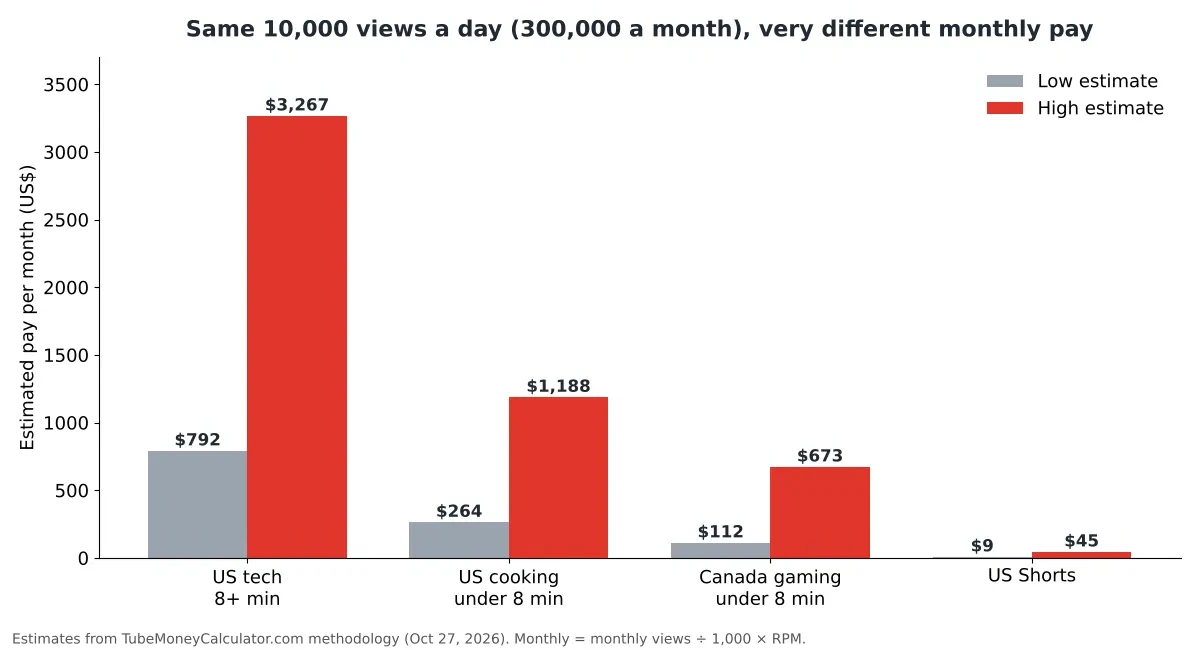
Notice how wide each range is. The high end is four to six times the low end in every long-form row, because the low and high estimates use different ad-market assumptions. Treat the range as the honest answer, not a rough guess at a single number.
How to work out your own monthly income (3 steps)
Step 1: Turn daily views into monthly views. Multiply your average daily views by 30. In YouTube Studio, the last 28 days is a convenient window: divide that total by 28, then multiply by 30. Using a 28-day total without adjusting will undercount a 30-day month by about 7%.
Step 2: Pick an RPM. Use the ranges in the table above for a quick estimate, or your own real RPM from YouTube Studio for accuracy. RPM depends on your niche, your audience’s country and whether your videos run longer than 8 minutes.
Step 3: Multiply. Monthly views ÷ 1,000 × RPM = monthly pay. Then, if you want the season included, multiply by that month’s seasonal factor (more on that below).
Here it is in one line: 30,000 monthly views ÷ 1,000 × $2.64 = $79.20, the low estimate for 1,000 tech views a day.
You can run these numbers yourself in the Earnings Estimator. Enter your monthly views, niche, audience country and video length, and it does the same steps for you.
Why the same views pay so differently
Niche. Advertisers pay more to reach some audiences than others. Our model uses a technology CPM of $8 to $22, food and cooking of $4 to $12, and gaming of $2 to $8. Finance pays more still, and music less. Same views, very different RPM.
Audience country. Viewers in the US are the reference point at a 1.00 multiplier. Canada is counted at 0.85, the UK at 0.88 and Australia at 0.90. That’s an estimate of how much advertisers in each market pay, not a YouTube rate.
Video length. Videos of 8 minutes or longer can carry mid-roll ads, so our model applies a 1.5× boost to those. A video just under 8 minutes doesn’t get that boost, which is why length matters as much as niche in the examples below.
Shorts. Shorts pay from a shared pool rather than per-video ads, at a far lower rate. A million Shorts views earn a small fraction of what a million long-form views earn. We cover why in how much YouTube Shorts pay per 1,000 views.
Worked example 1: a US tech channel at 10,000 views a day
Your videos are 8 minutes or longer, your audience is mostly in the US, and your niche is technology. Here is the RPM, using the methodology’s formula of CPM × country × monetized view rate × 55% creator share × length boost:
- Low RPM: $8 × 1.00 × 40% × 55% × 1.5 = $2.64 per 1,000 views
- High RPM: $22 × 1.00 × 60% × 55% × 1.5 = $10.89 per 1,000 views
At 10,000 views a day, that’s 300,000 views a month:
- Low: 300,000 ÷ 1,000 × $2.64 = $792 a month
- High: 300,000 ÷ 1,000 × $10.89 = $3,267 a month
Over a full year, using the calculator’s yearly total of 12.12 seasonal units (the twelve monthly factors added together), that becomes $9,599 to $39,596. The yearly figure isn’t exactly twelve times a single month, because the seasons aren’t equal.
Worked example 2: a Canadian gaming channel at 10,000 views a day
Gaming pays less per view, and a Canadian audience is counted at 0.85× the US rate. Videos here are under 8 minutes, so there is no mid-roll boost:
- Low RPM: $2 × 0.85 × 40% × 55% = $0.374 per 1,000 views
- High RPM: $8 × 0.85 × 60% × 55% = $2.244 per 1,000 views
At 300,000 views a month:
- Low: 300,000 ÷ 1,000 × $0.374 = $112.20 a month
- High: 300,000 ÷ 1,000 × $2.244 = $673.20 a month
Same daily views as the tech channel, and the gap is roughly 5 to 7 times, all from niche, country and length.
Worked example 3: Shorts at 10,000 and 100,000 views a day
Shorts pay at the US Shorts rate of $0.03 to $0.15 per 1,000 views, which our methodology still marks as provisional:
- At 10,000 a day (300,000 a month): 300 × $0.03 = $9, up to 300 × $0.15 = $45
- At 100,000 a day (3,000,000 a month): 3,000 × $0.03 = $90, up to 3,000 × $0.15 = $450
Now the February 1, 2027 change. From that date, a channel needs 10 million qualified Shorts views in the last 90 days to share in Shorts revenue, according to YouTube’s official announcement. At 100,000 views a day, a channel reaches 9 million in 90 days, just short of the line. Below it, the Shorts share pauses. The channel stays in the Partner Program and keeps earning from long-form.
To clear 10 million in 90 days, you’d need about 111,111 Shorts views a day. Our 10 million Shorts views rule guide explains the threshold in detail.
The same views won’t pay the same every month
Advertising prices follow the calendar. Our model uses a seasonal multiplier for each month, from January’s 0.75× to December’s 1.35×. Using the same 300,000 monthly views on the US tech channel, the midpoint of its range (about $2,030 a month) moves like this:
- January (0.75×): about $1,522 at the midpoint, or $594 to $2,450 across the range
- December (1.35×): about $2,740 at the midpoint, or $1,069 to $4,410 across the range
That’s roughly 44% less in January for identical views. It is a change in advertising prices, not a penalty on your channel. Our guide to why YouTube earnings drop in January covers why it happens and how to plan for it.
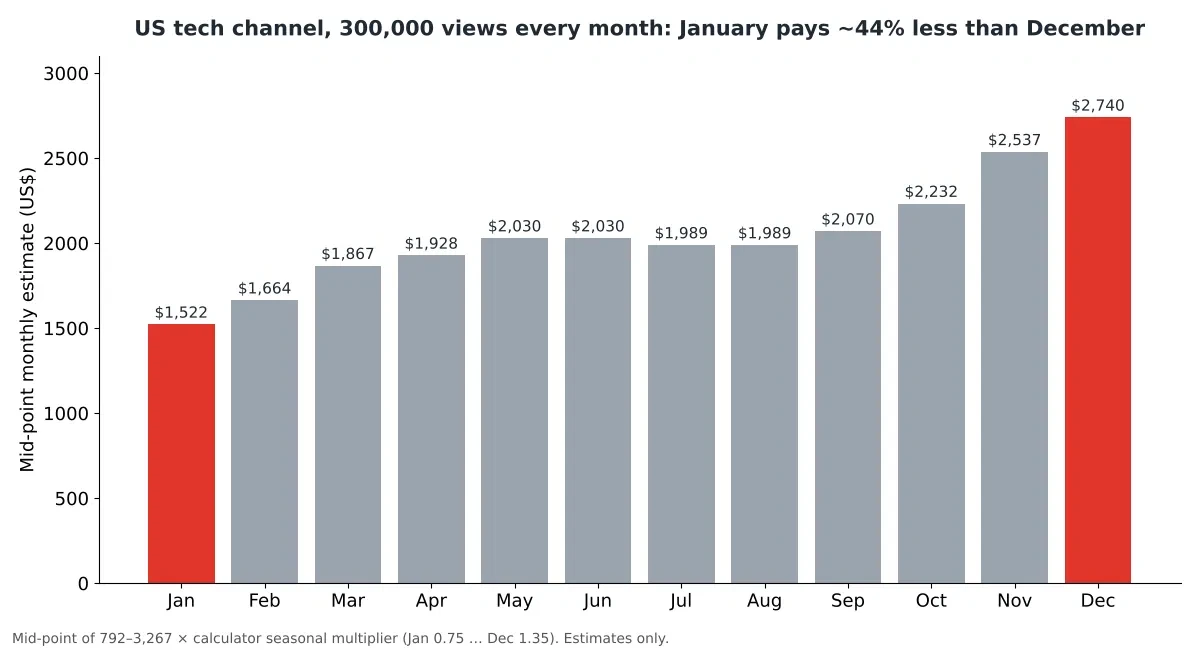
These seasonal figures come from our own planning model. YouTube doesn’t publish monthly multipliers, so your real swing may be larger or smaller.
How many views a day you need for $1,000 a month
Reverse the formula to set a goal. Views needed = $1,000 ÷ RPM × 1,000, then divide by 30 to get a daily figure.
- US tech, 8+ min: at $10.89 RPM, about 3,061 views a day. At $2.64, about 12,626 a day.
- US cooking, under 8 min: at $3.96 RPM, about 8,418 views a day. At $0.88, about 37,879 a day.
- Canada gaming, under 8 min: at $2.244 RPM, about 14,854 views a day. At $0.374, about 89,127 a day.
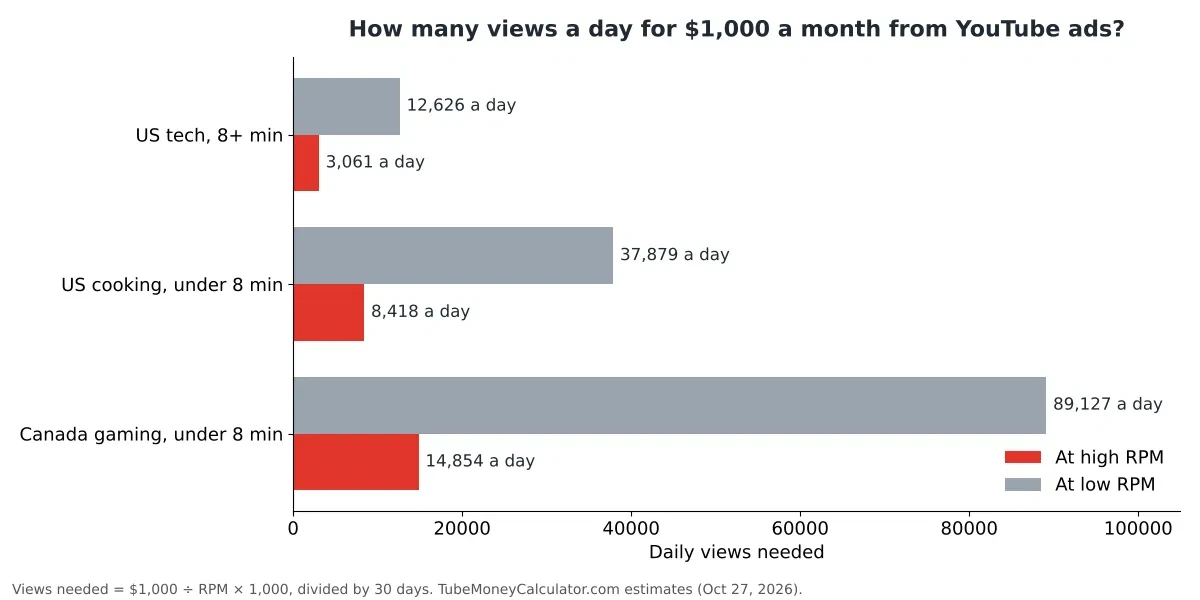
The lesson is the same one the examples keep teaching. Choosing a longer video in a higher-paying niche can cut the daily views you need by more than half.
Why your Studio number may not match
Your Studio revenue won’t always match these estimates, and that’s expected:
- Studio includes more than ads. RPM in YouTube Studio is calculated across ads, channel memberships, YouTube Premium, Super Chat and Super Stickers, so it can run above an ads-only estimate (YouTube Help).
- Revenue appears with a delay. Revenue takes about two days to show in Studio (YouTube Help).
- Final figures are set later. Earnings are finalized in AdSense for YouTube between the 7th and 12th of the following month, and that finalized figure is what gets paid.
If you want to compare your real RPM with our estimate, the calculator has a “Know your real RPM” check that lets you enter your own number.
Before any of this: you have to be in the Partner Program
Monthly pay from ads only starts once you’re in the Partner Program. Today, the ad-revenue level needs 1,000 subscribers plus 4,000 qualified watch hours in the last 12 months, or 10 million qualified Shorts views in the last 90 days (YouTube Help).
From February 1, 2027, new applicants need 1,000 subscribers plus 8,000 qualified watch hours in the last 365 days, or 20 million qualified Shorts views in the last 90 days. Channels already in the program are not affected by that entry bar. Everyone in the program must accept the updated terms in YouTube Studio by January 31, 2027.
Note what this means in practice: 1,000 views a day is about 30,000 a month. That’s a healthy audience, but it doesn’t qualify a channel on its own. Qualification depends on watch hours or Shorts views, which is a separate calculation. Our guide to how long 8,000 watch hours takes walks through it.
FAQ
Does YouTube pay a monthly salary?
No. Pay is based on views and RPM, so it moves every month. A flat monthly figure would imply a guarantee YouTube doesn’t offer. Use the daily-views math above to estimate a range instead.
How much does YouTube pay for 1,000 views a day?
For a long-form US tech channel, about $79 to $327 a month. For a US cooking channel under 8 minutes, about $26 to $119. For Shorts, about $1 to $5. These are estimates, and your own RPM should replace them once you have it.
Do subscribers increase monthly pay?
Not directly. Pay comes from views and their RPM, not from how many people have subscribed. Subscribers do help you qualify for the Partner Program and often watch more of your videos, which increases views. Those effects are indirect.
When does monthly money actually arrive?
Usually one to two months after you earn it. Money you earn in December is finalized in early January and paid between the 21st and 26th of January, if your balance is at least $100. Our guide to how YouTubers get paid has the full schedule.
Your next step
Open the Earnings Estimator and enter the views you get in a typical month, your niche, your audience’s country and your average video length. Then tick the seasonal option and look at December and January side by side. Those two numbers give you a realistic ceiling and floor for planning the year.
For the one-number version of this question, see how much YouTube pays for 1 million views, and for the per-view math behind everything here, read how much money you get per view on YouTube.
All figures here are estimates from our published methodology, not official YouTube rates. Rules checked on October 27, 2026. YouTube may change them before February 2027.