You’ve read that from February 1, 2027, new channels will need 8,000 watch hours to earn from ads. You make every video yourself. You have a job, or school, or kids, and maybe ten spare hours a week. Every growth video you watch says “post every day.” You can’t. So you either freeze, or you upload whatever you can and hope. Neither one gets you closer.
This is a 90-day growth plan built for exactly that person: one creator, limited time, and new rules. It has three short phases, four numbers to track, and the real math, so you always know where you stand.
Short answer: Most solo creators will not reach 8,000 watch hours in 90 days, and that’s fine. A good 90-day plan picks one topic people search for, publishes long videos at a pace you can keep, and tracks four numbers every week so you make more of what works. By day 90, you want your monthly watch time climbing toward 667 hours a month. That’s the pace that adds up to 8,000 hours in a year.
The rules this plan is built around (checked October 20, 2026)
Here is what YouTube has confirmed. I checked each point against YouTube’s official announcement and its Partner Program Help page. The rules may change before February, so check those pages again before you make big decisions.
- New applicants from February 1, 2027: to share in ad and Premium revenue, you need either 8,000 qualified watch hours in the last 365 days or 20 million qualified Shorts views in the last 90 days.
- Subscribers: the announcement does not mention a change to subscribers. Today’s Help page lists 1,000 subscribers for the ad-revenue level.
- Shorts don’t add watch hours. The Help page says only public long-form videos count. Watch time from the Shorts feed, private or unlisted videos, and ads does not count.
- The first (fan-funding) level is unchanged: 500 subscribers, 3 public uploads in the last 90 days, and either 3,000 watch hours in 12 months or 3 million Shorts views in 90 days (expanded YPP Help page).
- Existing partners are not affected by the new entry bar. The Help page asks them to accept the updated terms in YouTube Studio by January 31, 2027.
- New bonuses for Shopping, brand deals and trends: YouTube says “more details soon.” Not announced yet.
- Stay active: YouTube may turn off monetization for channels that haven’t uploaded or posted in six months or more.
The one number to remember: 667 hours a month
The 8,000 hours are counted over a rolling 365 days. Every day, new hours come in and hours older than a year drop out. So the real target isn’t a one-time total. It’s a steady speed.
- 8,000 hours ÷ 365 days = 21.9 hours a day
- 21.9 × 30.4 days = about 667 hours a month (or about 614 in YouTube Studio’s 28-day view)
- For the 3,000-hour fan-funding level: 3,000 ÷ 12 = 250 hours a month
To turn hours into views, use this simple formula: watch hours = views × average minutes watched ÷ 60. Flip it around, and you get the views you need each month:
| Average view duration | Views needed per month for 667 hours | Views per day |
|---|---|---|
| 3 minutes | 13,333 | ≈ 438 |
| 4 minutes | 10,000 | ≈ 329 |
| 5 minutes | 8,000 | ≈ 263 |
| 6 minutes | 6,667 | ≈ 219 |
| 8 minutes | 5,000 | ≈ 164 |
Look at that table for a moment. Moving your average view duration from 4 minutes to 6 minutes cuts the views you need by a third. For a small channel, keeping viewers longer is often easier than finding more of them. That’s why the plan below spends so much time on the first 30 seconds and on what people watch next. For the full math on timelines, see How Long Does It Take to Get 8,000 Watch Hours?.
The 90-day plan
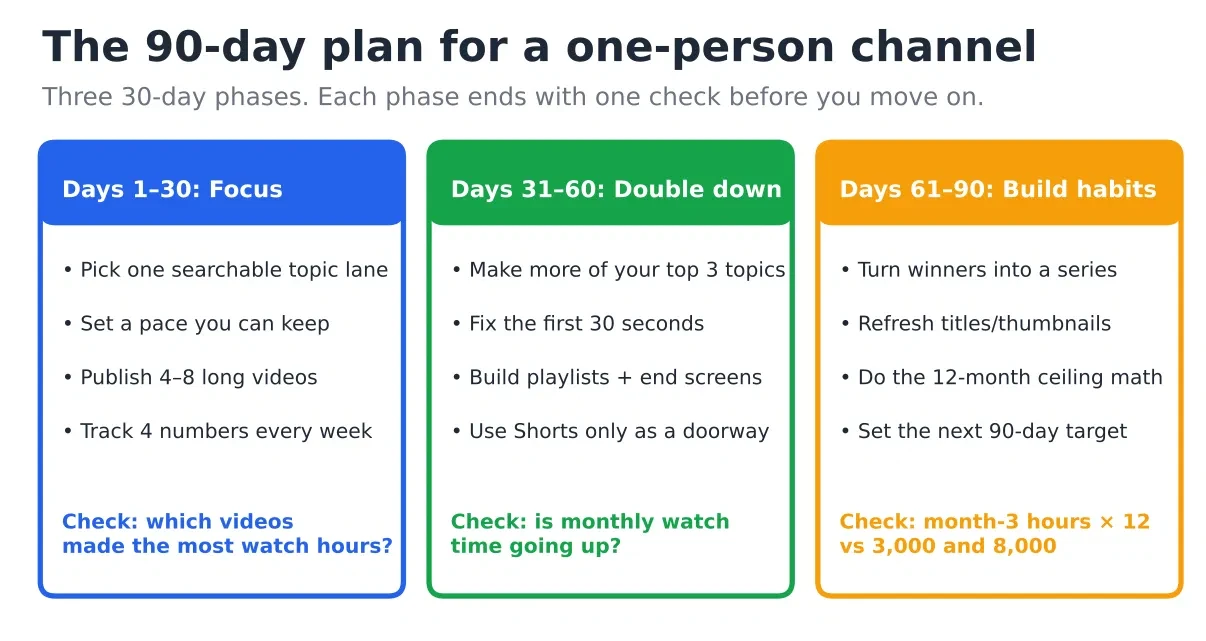
Before day 1: set a pace you can keep
Look at your last video and write down how many hours it really took, from idea to upload. Then divide your weekly free time by that number. If a video takes you 8 hours and you have 10 hours a week, your honest pace is one long video a week. Two a week means burnout by week five.
One a week is enough. It also covers the “3 public uploads in 90 days” rule for the fan-funding level with lots of room to spare.
Days 1–30: Focus
- Pick one topic lane. “Budget home repairs for renters” is a lane. “My life” is not. A narrow lane helps YouTube learn who to show your videos to.
- Write down 20 real questions. Type your topic into YouTube’s search bar and note what it suggests. Each question that people already search for can become one video. Search keeps bringing views for months, which is what a rolling 365-day window rewards.
- Make long-form videos only as long as the topic needs. Longer videos help only if people keep watching. Ten tight minutes beat twenty slow ones.
- Publish 4–8 long videos at your chosen pace.
- Start the weekly scorecard (below). It takes 10 minutes every Sunday.
End-of-phase check: In YouTube Studio, go to Analytics → Content and sort your videos by watch time. Which 3 videos earned the most hours?
Days 31–60: Double down
- Make two follow-ups for each of your top 3 videos. Same viewer, next question. If “how to fix a running toilet” worked, “how to fix a toilet that won’t flush” is a strong next step.
- Fix your first 30 seconds. YouTube’s key moments report shows how many viewers are still watching after 30 seconds. YouTube’s advice is to make your title and thumbnail match what the video delivers and to try different openings. In practice, that means skipping the long hello and starting with the answer you promised.
- Link each video to the next one. Use playlists, end screens and a pinned comment pointing to your best related video. One viewer watching two videos gives you twice the minutes.
- Use Shorts only as a doorway, if you have time. Shorts views add zero watch hours. One or two Shorts a week that link to a related long video can still bring new viewers to the videos that count. See Do YouTube Shorts Count Toward Watch Hours?
- Don’t panic over click-through rate. YouTube says half of all channels and videos fall between 2% and 10%. It also says to compare over the long term and not check right after uploading.
End-of-phase check: Is month 2’s watch time higher than month 1’s? If not, look again at your top 3 topics before making more videos.
Days 61–90: Build habits
- Turn your best topic into a series with a clear playlist name. Series make it easy for someone to binge-watch, and bingeing adds watch hours.
- Refresh the packaging on underperformers. If a video keeps people watching but few people click on it, try a clearer title or thumbnail. Change one thing, then wait a couple of weeks.
- Do the ceiling math: this month’s watch hours × 12. Compare the result to 3,000 (fan-funding level) and 8,000 (ad level).
- Set the next 90-day target, such as “raise monthly hours by 50%.” Make it a number you control, like average view duration, rather than “go viral.”
What not to do, ever: sub-for-sub swaps, bought views, or re-uploading other people’s videos. These break YouTube’s rules. They can also get your monetization application rejected, which hurts far more than slow growth.
Your weekly scorecard
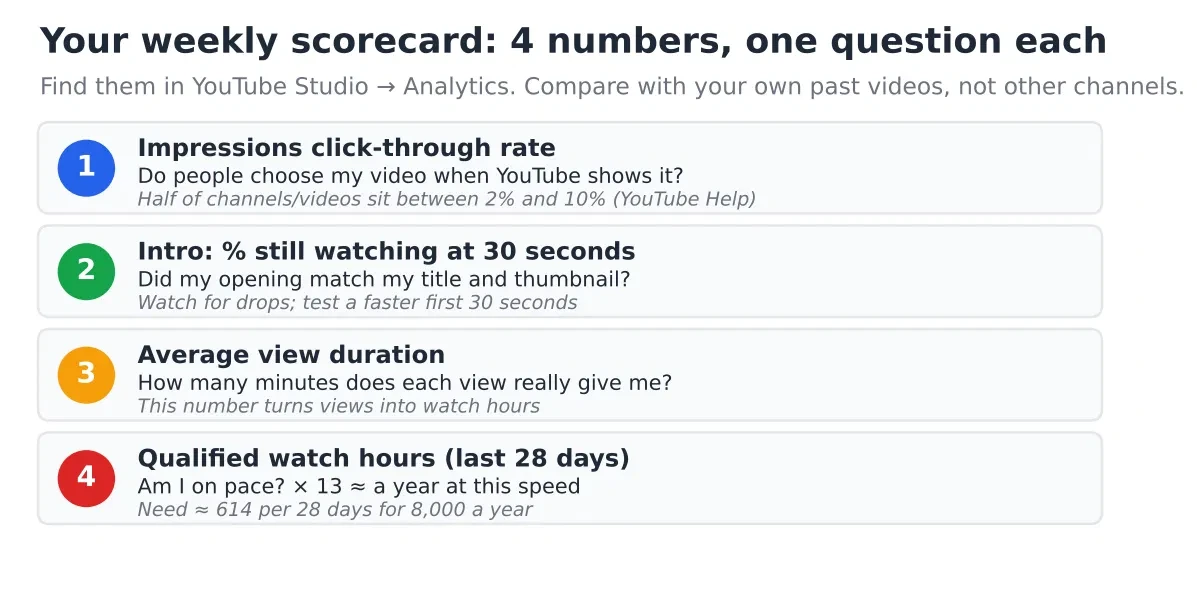
Write these four numbers in a notebook or a simple sheet every week. Compare them with your own earlier videos, not with big channels. One rule makes this work: change one thing at a time, so you know what helped.
Worked example 1: a US tech channel, one video a week
Here’s an example, not a promise. A solo creator makes 12-minute software tutorials for a mostly US audience. The average viewer watches 5 minutes. Over 90 days, they publish 13 videos.
| Month | Views | Watch hours (views × 5 ÷ 60) |
|---|---|---|
| Month 1 | 1,500 | 125 |
| Month 2 | 3,000 | 250 |
| Month 3 | 5,000 | 417 |
| Total | 9,500 | 792 |
- Ceiling check: 417 × 12 = about 5,000 hours a year at the month-3 pace.
- That’s above 3,000, so the fan-funding level is in reach on hours (they still need 500 subscribers).
- It’s below 8,000. To get there at 5 minutes per view, they need 8,000 views a month. If they raise the average to 6 minutes, they need only 6,667.
What it could earn once accepted: our calculator’s methodology gives US technology videos of 8+ minutes an estimated RPM (earnings per 1,000 views) of $2.64–$10.89. Here’s the math: CPM $8–$22 × 40–60% monetized views × 55% creator share × 1.5 mid-roll boost. At 8,000 views a month, that’s 8 × $2.64 = $21 up to 8 × $10.89 = $87 a month, before seasonal changes. That’s real but modest. The first year of growing a channel is about building the engine, not the paycheck.
Worked example 2: a Canada cooking channel, two videos a week
A second creator posts two 9-minute recipe videos a week (26 in 90 days) for a mostly Canadian audience. The average viewer watches 3.5 minutes.
| Month | Views | Watch hours (views × 3.5 ÷ 60) |
|---|---|---|
| Month 1 | 2,000 | 117 |
| Month 2 | 4,500 | 263 |
| Month 3 | 8,000 | 467 |
| Total | 14,500 | 846 |
- Ceiling check: 467 × 12 = about 5,600 hours a year.
- To reach the 8,000-hour pace at 3.5 minutes, they need 11,429 views a month. At 4.5 minutes, the number falls to 8,889. For this creator, a tighter intro may do more than a third video each week.
- Earnings once accepted: food & cooking CPM $4–$12 × Canada 0.85 × 40–60% × 55% × 1.5 = an RPM of $1.12–$5.05. At 11,429 views a month, that’s about $13–$58 a month.
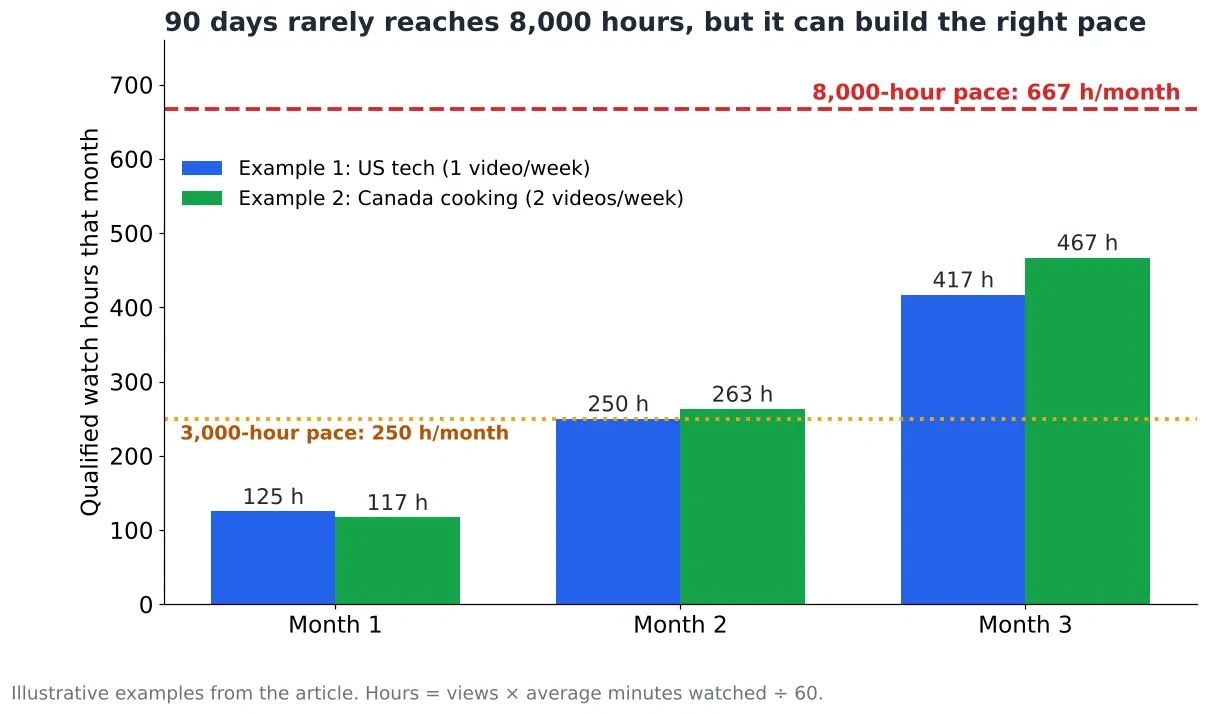
Both creators did well, and neither reached 8,000 hours in 90 days. Both reached the 250-hour pace for the fan-funding level by month 2, and both learned which topics work. That’s what a good first 90 days looks like.
What this plan can’t do
- It can’t guarantee results. Your topic, your video quality and what viewers want all matter, and nobody controls YouTube’s recommendations.
- The earnings above are estimates from our calculator. They don’t include YouTube Premium revenue, and your real RPM will differ. Check your own numbers in YouTube Studio once you’re in.
- Some 2027 details, like the new Shopping and brand-deal bonuses, are not announced yet. If you’re curious about other ways to earn while you grow, see How to Make Money Before 8,000 Watch Hours.
FAQ
Can I get 8,000 watch hours in 90 days?
It’s possible, but you’d need about 2,667 hours a month. At a 5-minute average view, that’s roughly 32,000 views a month. For most brand-new solo channels that’s a big jump, so treat 90 days as the time to build your pace, not to finish.
Should I still post Shorts?
Shorts views don’t add watch hours. If your time is tight, put long videos first. If you have spare time, one or two Shorts a week that point to a related long video can help new viewers find you.
How many videos a week should a solo creator post?
As many as you can keep up for 90 days without your quality dropping. For most people working alone, that’s one or two long videos. A steady pace beats a burst followed by silence.
I’m already in the Partner Program. Does this plan matter to me?
The new entry bar doesn’t apply to you. Remember to accept the updated terms in YouTube Studio by January 31, 2027. If you earn from Shorts, read about the 10 million Shorts views rule. The growth steps above still help you earn more from long videos.
Do I still need 1,000 subscribers?
YouTube’s announcement doesn’t mention changing it, and the Help page still lists 1,000 subscribers for the ad-revenue level. Recheck the official Help page closer to February. Our summary of every February 2027 change covers the rest.
Your next step
Today, pick your topic lane and write down 20 questions people search for. Then make one video from the best one this week. When you want to see what your channel could earn once it qualifies, open the YouTube Money Calculator. Use the Goal Calculator to see how many monthly views your income goal needs for your niche and country. Then come back to your scorecard every Sunday. Ninety days from now, you’ll have real numbers to work with instead of guesses.